Before an MSME payment claim, build the evidence file
An invoice is overdue. The supplier has delivery records, the buyer mentions a quality issue, and the accounts teams disagree about which payment cleared which bill. Uploading the invoice alone will not resolve those differences.
A useful delayed-payment reference connects the transaction, the payment clock and the amount claimed. It also identifies problems before an opponent does. This guide explains how to prepare that file for legal assessment; the document structure below is an editorial recommendation, not a statutory form or a guarantee of admission or recovery.
First establish which route fits the supplier
The Ministry describes the delayed-payment mechanism for micro and small enterprises with valid Udyam registration. A medium enterprise does not acquire the same route merely because all three categories appear in “MSME”. Check the supplier’s activity, legal entity, classification and relevant registration history against the transaction. A certificate obtained today does not, by itself, answer every question about an earlier supply. Ministry of MSME: eligibility
Keep the contract, supply and registration dates together. In NBCC (India) Ltd. v. State of West Bengal, 2025 INSC 54, paragraphs 29–30, the Supreme Court referred the registration issue to a three-judge Bench. That reference should not be presented as an automatic retrospective entitlement or an outright overruling. Ask counsel to check the current controlling position and the particular facts before choosing a forum. Official judgment, 10 January 2025
Reconstruct the payment clock, not just the invoice age
The familiar “45-day rule” is a ceiling on a payment period agreed in writing, measured from acceptance or deemed acceptance. A shorter written term matters. Without that agreement, section 15 requires payment before the statutory appointed day: the day immediately after fifteen days expire from acceptance or deemed acceptance under section 2(b).
Acceptance may depend on a written objection made within fifteen days of delivery or performance and when the supplier removes it. Without such an objection, deemed acceptance relates to actual delivery or performance. The invoice date alone cannot establish this sequence. Sections 16–17 provide for statutory interest, including monthly compounding at three times the RBI-notified bank rate; the bank rate should not be confused with the repo rate. MSMED Act: sections 2(b), 15–17
For every invoice, record the relevant events separately. Avoid assigning one assumed acceptance date to a whole year’s ledger.
Build a file another person can reconcile
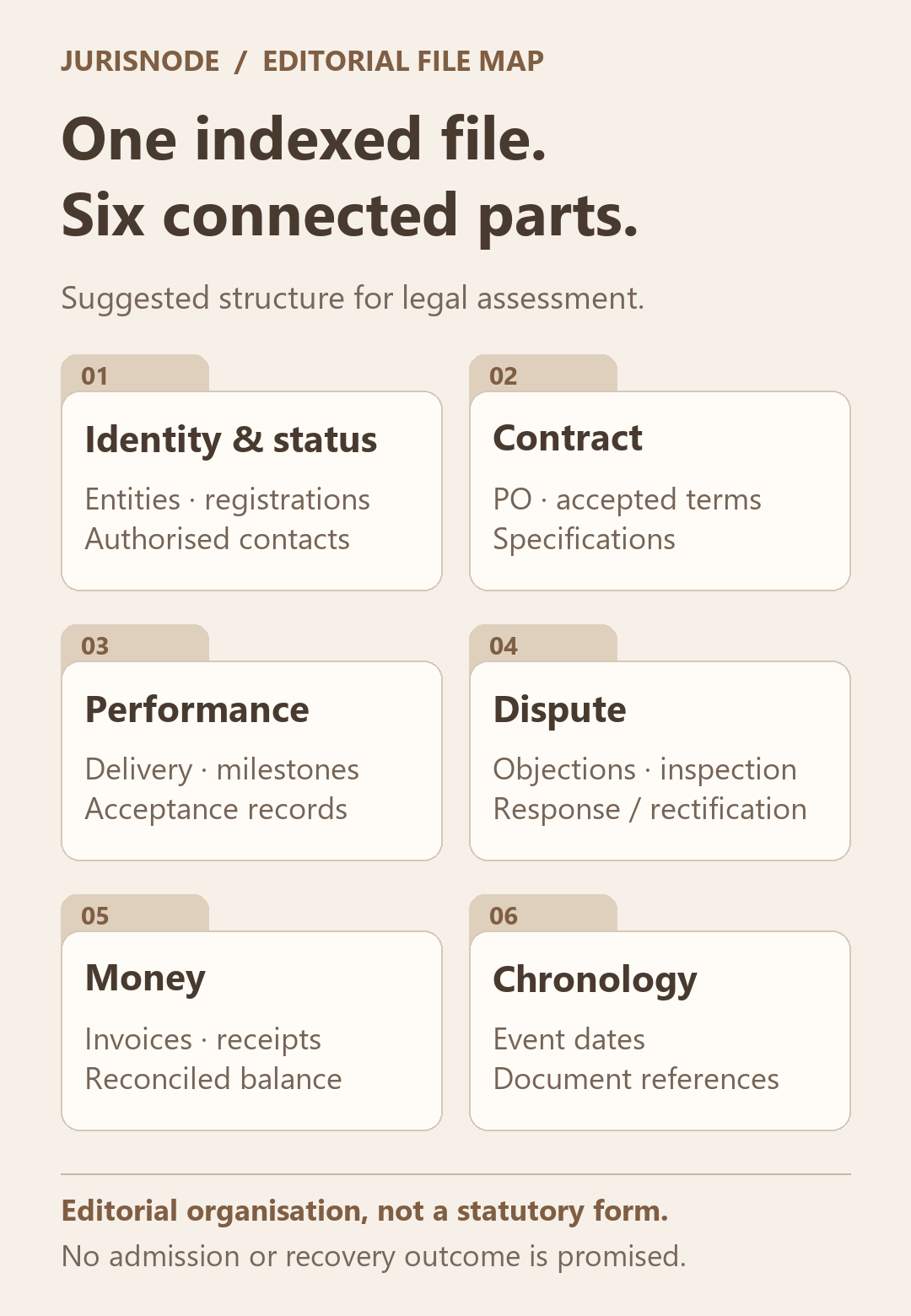
Create an indexed folder with six parts:
| Part | What it should connect |
|---|---|
| Identity and status | Correct supplier and buyer entities; relevant registrations; authorised contacts |
| Contract | Purchase order, accepted quotation, written terms, amendments and specifications |
| Performance | Dispatch and delivery evidence, service milestones, acknowledgements and acceptance records |
| Dispute | Buyer’s objections, their dates, inspection material and the supplier’s response or rectification |
| Money | Invoices, receipts, allocations, credit notes, returns and the reconciled outstanding balance |
| Chronology | A dated sequence with a document reference for each material event |
Use a stable identifier such as “INV-014 / delivery acknowledgment / 8 June”. Preserve originals and complete email threads; a cropped screenshot can conceal the preceding qualification. Do not silently “clean up” an inconvenient message or replace an original document with a rewritten summary.
Then prepare an invoice-wise reconciliation showing gross amount, each adjustment, each receipt, remaining principal and the calculation cut-off. Explain payment allocations when the buyer’s ledger differs. A bank credit proves receipt of money; it may not explain which disputed invoice the parties intended to discharge.
Prepare interest as a separate, reproducible worksheet, with the proposed start date, rate source, periods and treatment of credits. Have the legal and arithmetic basis checked before treating that calculation as an entitlement.
Put the buyer’s objection in the file
Suppose goods were delivered, a written specification complaint followed, and replacement material was later sent. A demand that omits the complaint or replacement date is easier to challenge.
Identify what was objected to, when, by whom and with which supporting material. Distinguish a disputed quantity from a disputed price and a claimed set-off. Preserve trial reports, weighment records, return documents or service sign-offs where relevant.
An objection arriving outside the statutory fifteen-day window still needs legal assessment. Do not convert the acceptance provisions into a claim that every late complaint disappears or that the invoice amount has automatically been proved.
Assess limitation before spending time on a portal
Old debts require a legal chronology as well as an accounts ledger. In Sonali Power Equipments Pvt. Ltd. v. Chairman, Maharashtra State Electricity Board, 2025 INSC 864, the Supreme Court distinguished conciliation under section 18(2) from arbitration under section 18(3). Its conclusion states that limitation does not apply to the former, while it applies to the latter. It also treats an alleged acknowledgment in financial statements as requiring case-specific examination. Official judgment, 17 July 2025, paragraphs 48–51
Neither “all old claims are dead” nor “MSME registration revives every invoice” is an adequate assessment. Flag due dates, signed acknowledgments, part-payments and earlier proceedings for counsel. Do not assume that sending reminders or uploading documents stops a limitation clock. Identify the relevant proceeding and the legal effect of each event.
Use the current filing route and check the 2026 changes
The Samadhaan page checked on 18 October 2026 directs new delayed-payment applications to the MSME ODR Portal. Follow that current official route and the applicable Council’s requirements, rather than an old tutorial. An online acknowledgment is evidence of a submission, not proof of jurisdiction, an award or payment. Keep its reference and the exact uploaded bundle. Official Samadhaan notice, MSME ODR Portal
There is also a genuine 2026 legislative update. The Amendment Act received assent on 13 August 2026; its section 1(2) provides for commencement through government notification, potentially on different dates for different provisions. Before filing, check the operative commencement notifications, applicable rules and dispute-process provisions. Assent alone should not be used to promise a new procedure or recovery deadline. Official 2026 Amendment Act
End with a decision-ready brief
Give the adviser one page identifying the parties, transaction, outstanding principal, disputed issues, key dates, proposed route and missing evidence. Attach the indexed documents and reconciliation. Include existing arbitration clauses or proceedings so parallel actions are considered deliberately.
A documented payment proposal or settlement discussion may be useful; record what is admitted, disputed and conditional. Ordinary non-payment does not, by itself, establish a criminal offence. A police complaint should not become a routine collection threat.
The practical gain from this preparation is a claim that can be examined, corrected and explained. Eligibility, procedure, outcome and enforcement remain separate questions. A strong evidence file improves the quality of those decisions without promising their result.
Article enquiries
Email: dalmiasiddharth1994@gmail.com
Phone: +91 99717 99250