BSA section 90: what an email record does not establish about its sender
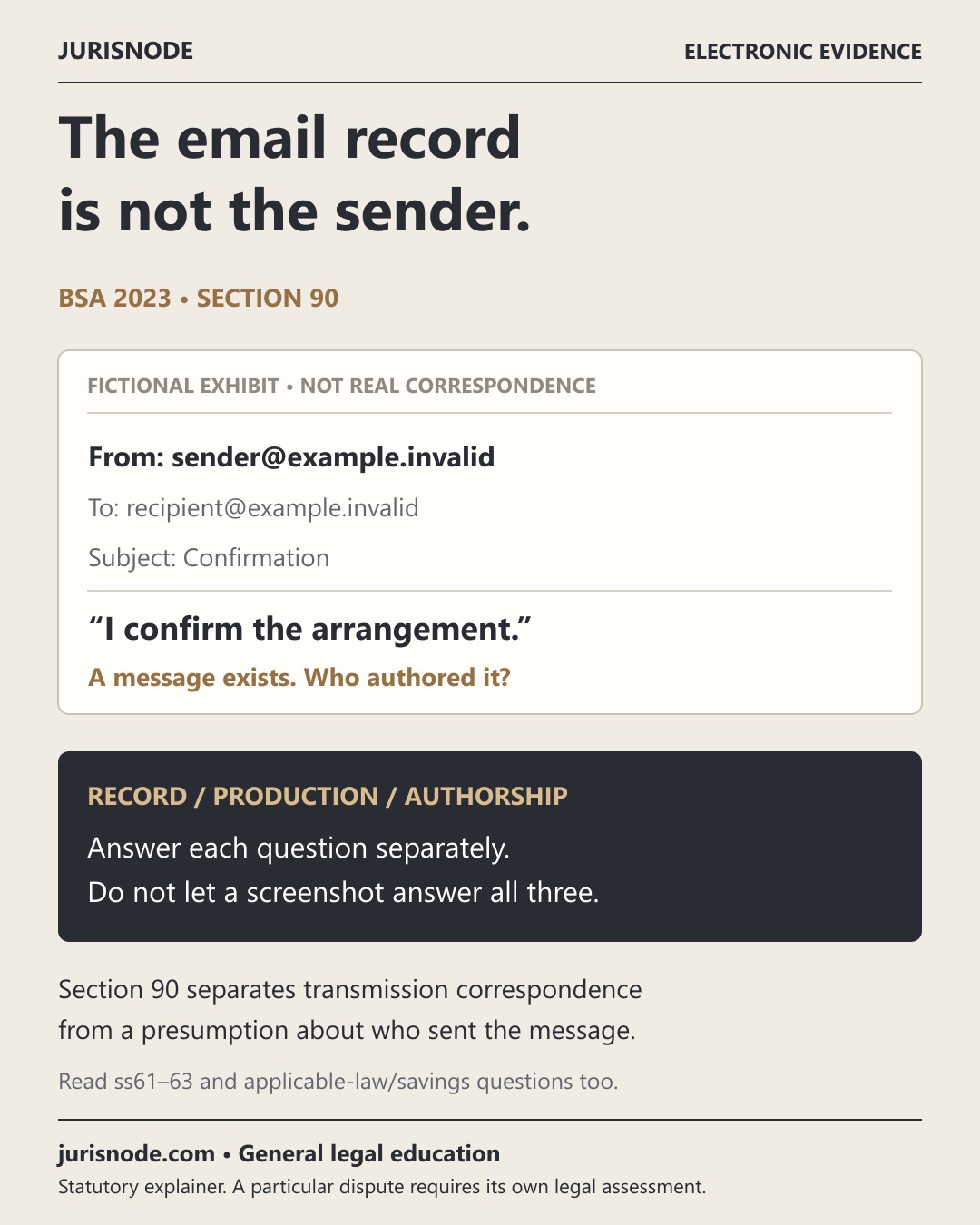
An email printout shows an address, a date and the words “I confirm the arrangement.” One party says a particular person sent it. The other disputes that person’s involvement. Does the message itself settle the disagreement?
Section 90 of the Bharatiya Sakshya Adhiniyam, 2023 draws a useful distinction. It permits a presumption about correspondence between a message transmitted through an electronic mail server and the message fed into the computer for transmission. It expressly excludes a presumption about the person who sent it. The record and the sender’s identity therefore need separate attention. Read section 90 in the official text, PDF page 35
Read both halves of the rule
The first half is permissive. “May presume” is not a command to accept every email at face value. Section 2(1)(h) allows the court either to treat the relevant fact as proved unless disproved or to call for proof. The second half limits what section 90 supplies: the sender’s identity cannot simply be presumed under that provision. Definition of “may presume”, PDF page 11
That does not make identity impossible to prove. It means this particular presumption does not do that work. Identify the evidence actually relied upon and the proposition it is offered to establish.
Keep two further questions visible. Is the statement in the message true? If someone sent it for a company, did that person have authority for the particular transaction? Do not use a transmission-related presumption as a shortcut to either conclusion.
Work through the fictional email
The accompanying illustration uses sender@example.invalid, a recipient address and the sentence “I confirm the arrangement.” It is invented correspondence, not a court exhibit or a report of a decided case.
Suppose it is offered to show that a director approved revised delivery terms. Start with the disputed proposition, then examine the record:
| Question | What the reading note should identify |
|---|---|
| What item is being examined? | An email file, printout, screenshot or another representation; identify which one rather than treating them as interchangeable. |
| What does the message actually say? | The complete relevant wording, surrounding thread and any attachment referred to—not an isolated confirmation stripped of its subject. |
| How was this item obtained and produced? | Its known source, the production steps and the person who can explain them; leave gaps visible. |
| What identifies the alleged sender? | The particular material relied upon to connect a person with the message, and what remains disputed. A displayed name is an assertion to examine. |
| What transaction is said to have been authorised? | The relevant terms and the separate basis for saying the sender could approve them. |
The last two rows matter even when the message wording is undisputed. An authentic copy of the words does not answer every question about who used an account or what an ambiguous confirmation covered.
These are questions for organising a legal reading and discussion. They are not a forensic preservation protocol or a declaration that the listed material will be sufficient for a court.
Examine production and admissibility separately
Sections 61–63 address electronic records and their proof. Their conditions, including the certificate provisions where applicable, require examination for the actual record and production route. Section 90 should not be used to skip that analysis. Electronic-record provisions, PDF pages 29–31
For example, a cropped screenshot can omit the preceding question or the attachment that explains “the arrangement.” A forwarded copy may require an explanation of the source and steps that produced the item being examined. The sensible response is to identify the missing context and obtain appropriate advice, rather than invent facts to make the record look complete.
Equally, avoid a blanket assertion that screenshots prove nothing or are always inadmissible. A technical form, a certificate and a displayed address each need to be related to the issue they are said to resolve. Do not assume that satisfying one question automatically establishes all the others.
Check which evidence law governs
Section 170 contains a savings provision for specified matters pending immediately before commencement. The fact that an email is being discussed today does not, by itself, decide whether the BSA governs the proceeding. Record the relevant procedural history and have the applicable law checked. Repeal and savings, PDF page 51
This article explains a statutory distinction; it does not claim to settle later judicial interpretation, the sufficiency of a particular certificate, or the outcome of a disputed transaction. Those issues require the appropriate current research and legal assessment.
The useful habit is simple: name the record, explain its production, and state separately what connects it to a person and a transaction. Keep an unanswered question visible instead of allowing one email screenshot to answer all of them.
Primary text checked 18 October 2026. General legal education. Editorial draft; qualified legal editorial review remains required. No author or advocate-review claim has been assigned.
Article enquiries
Email: dalmiasiddharth1994@gmail.com
Phone: +91 99717 99250