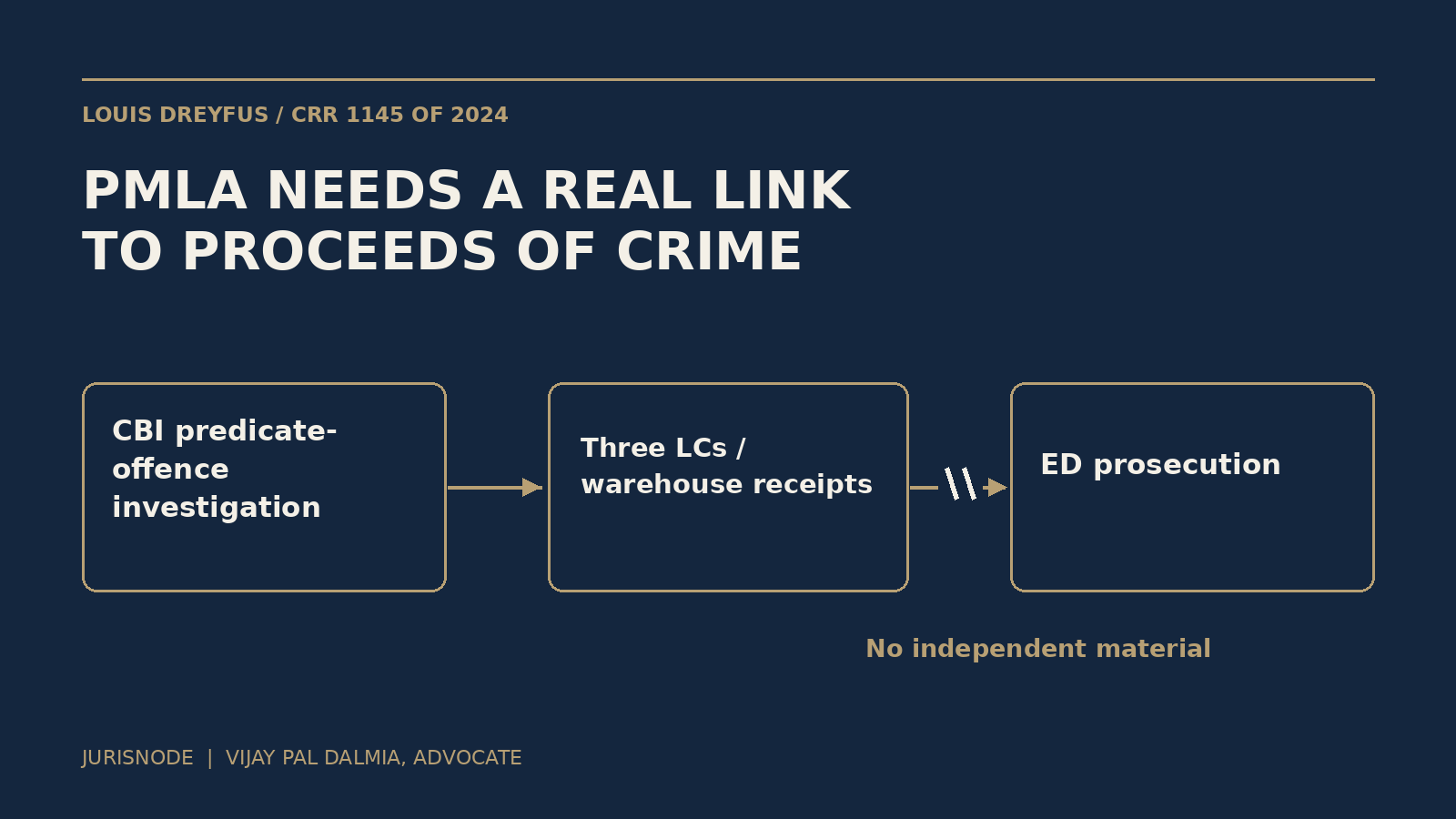
Louis Dreyfus Company India Private Limited v. Enforcement Directorate, Government of India, CRR 1145 of 2024, Calcutta High Court, decided 22 May 2026
Three letters of credit, a chain of commodity trades, and two investigations produced a difficult question under the Prevention of Money Laundering Act, 2002: can the Enforcement Directorate put a company on trial when the agency investigating the scheduled offence had already examined the same transactions, found no diversion of funds by that company, and did not name it as an accused?
In Louis Dreyfus Company India Private Limited v. Enforcement Directorate, the Calcutta High Court answered that question on the particular record before it. Justice Suvra Ghosh quashed M.L. Case No. 7 of 2018 only as against Louis Dreyfus Company India Private Limited, while allowing the case to continue against the other accused. The decision does not say that a person must be an accused in the scheduled offence before Section 3 of the PMLA can apply. It says something narrower and commercially important: an independent money-laundering prosecution still needs material linking the person and the property to “proceeds of crime”; it cannot rest on a recycled allegation and a co-accused’s statement when the same transactions were specifically investigated in the predicate case and yielded a contrary conclusion.
How the dispute arose
The case originated in a CBI FIR registered on 31 March 2014 against Manoj Kumar Jain, a director of Prakash Vanijya Private Limited, and others. The complaint by the Central Bank of India alleged a loss of approximately ₹234.57 crore. The CBI filed a charge-sheet and supplementary charge-sheet for offences including cheating, forgery, use of forged documents and conspiracy under the Indian Penal Code, together with offences under the Prevention of Corruption Act. These included scheduled offences for PMLA purposes.
The ED thereafter registered ECIR No. KLZO/9/2016 on 5 September 2016 and filed a prosecution complaint. Its case against Louis Dreyfus concerned three letters of credit aggregating ₹25 crore. The ED alleged circular trading: Louis Dreyfus purchased wheat and maize from Quality Vintrade Private Limited and sold the commodities on the same day to Prakash Vanijya. Payments moved through the chain after the letters of credit were discounted. The ED alleged that Louis Dreyfus received a benefit of ₹22,40,809 connected with proceeds of crime and projected it as untainted.
Louis Dreyfus maintained that these were ordinary commodity transactions conducted through warehouse receipts. Its case was that title to goods stored in a warehouse could pass without physical movement of the goods. It also relied on the CBI’s treatment of the very same transactions: the company was not charge-sheeted; its authorised representative was cited as a prosecution witness; and the predicate-offence investigation did not establish diversion of funds or identify the company as a beneficiary.
The first principle: a PMLA accused need not be a predicate-offence accused
The High Court expressly preserved the independent character of the money-laundering offence. A person who was not named in the scheduled offence can still be prosecuted under Section 3 if that person later conceals, possesses, acquires, uses, projects or claims as untainted property that qualifies as proceeds of crime. This follows the statutory structure of Sections 2(1)(u) and 3 of the PMLA and the Supreme Court’s analysis in Vijay Madanlal Choudhary v. Union of India.
That proposition prevents the judgment from being read too broadly. Mere absence from the predicate charge-sheet is not immunity. The decisive inquiry remains whether the material prima facie connects the accused to property derived or obtained from criminal activity relating to a scheduled offence.
The decisive distinction: omission after a transaction-specific investigation
The Court drew a sharp distinction between two situations. In the first, a person is simply not named in the scheduled offence but appears later in the process or activity involving proceeds of crime. In the second, the predicate-offence investigator has specifically examined that person’s role in the very transactions relied upon by the ED and has found no diversion, no benefit and no criminality attributable to that person.
Louis Dreyfus fell, on the Court’s assessment, into the second category. The CBI had dealt with the three disputed letters of credit and the company’s role. Its tabulation of beneficiaries and amounts allegedly routed back through circular trading did not identify an amount involving Louis Dreyfus. The High Court therefore treated the ED’s case as a reiteration of the subject matter already investigated, without fresh independent material sufficient to require the company to stand trial.
This is the centre of the judgment. The ED’s jurisdiction is independent, but not detached from the existence of proceeds of crime. Independence of the PMLA offence does not dispense with proof of the statutory link between the property, the scheduled criminal activity and the accused’s process or activity concerning that property.
Warehouse-receipt trading was not automatically a “paper transaction”
The ED relied on the same-day purchase and resale of commodities and the absence of physical movement to describe the trades as transactions only on paper. The Court declined to treat that description as self-proving. It noted that transactions through warehouse receipts are recognised under the Warehousing (Development and Regulation) Act, 2007. Transfer of title to warehoused goods does not invariably require the goods to be physically transported each time ownership changes.
The judgment does not validate every warehouse-receipt transaction or rule out sham trading. It requires the allegation to be tested against the governing commercial framework and evidence. Here, Quality Vintrade—the alleged seller and recipient in the circular chain—had not been arraigned in either the predicate case or the PMLA case. That omission further weakened the prima facie allegation that the transaction chain itself was illegal.
A co-accused’s Section 50 statement cannot be the starting point
The ED primarily relied on a statement made by Manoj Kumar Jain under Section 50 of the PMLA. The High Court applied the evidentiary approach reflected in Prem Prakash v. Union of India, Kashmira Singh v. State of Madhya Pradesh and Surinder Kumar Khanna v. Directorate of Revenue Intelligence: the prosecution should first marshal the evidence against the accused without using the co-accused’s confession as its foundation. Such a statement may support other evidence; it should not create the case by itself.
On the record before it, the Court found no prima facie independent material establishing that Louis Dreyfus was a beneficiary of proceeds of crime. The statement could not fill that foundational gap.
Why the Court quashed the proceeding
The High Court combined four features:
- the CBI had specifically investigated the three letters of credit and Louis Dreyfus’s role;
- the predicate investigation did not establish diversion of funds or identify the company as a beneficiary;
- the warehouse-receipt transactions could not be dismissed as fictitious merely because the goods did not physically move on each transfer; and
- the ED lacked prima facie independent material beyond its reliance on the co-accused’s Section 50 statement.
Relying also on the principle in Deepakbhai Jagdishchandra Patel v. State of Gujarat that even a strong suspicion at the charge stage must rest on material capable of becoming evidence at trial, the Court held that making the company undergo a prolonged trial would amount to abuse of process. It allowed CRR 1145 of 2024 and quashed the PMLA case only insofar as Louis Dreyfus was concerned.
What the judgment does—and does not—mean
The ruling should not be reduced to the slogan that “no predicate charge means no PMLA case.” The Court expressly rejected that absolute proposition. A person outside the scheduled-offence case can still face PMLA proceedings where independent material shows knowing involvement with proceeds of crime.
The more accurate proposition is this: where the predicate investigator has examined the precise transactions and the person’s role, has not found diversion or benefit, and the ED presents no independent material that supplies the missing link, the independent nature of the PMLA offence does not permit prosecution on a merely notional foundation.
Practical lessons for companies, directors and financial institutions
- Map the alleged property. Identify the specific property said to be derived from the scheduled offence. A general allegation of suspicious commerce is not a substitute for the Section 2(1)(u) link.
- Compare the two investigative records. Examine what the predicate FIR, charge-sheet and supplementary charge-sheet say about the same transaction, person and benefit. Silence is relevant, but an express transaction-specific investigation is more significant.
- Preserve the commercial evidence. Contracts, invoices, warehouse receipts, inventory records, payment chronology, credit terms and tax records may determine whether an unusual-looking trade is legitimate or a sham.
- Test for independent ED material. Ask what exists apart from a co-accused’s statement: bank trails, communications, control evidence, false documents, beneficial ownership material or other admissible evidence.
- Do not confuse speed with fiction. Same-day purchase and resale, netting arrangements or transfer of warehouse title can be commercially lawful, but they should be documented with unusual care.
- Keep the limits of quashing in view. Courts do not conduct a mini-trial at the threshold. Relief depends on showing that even the prosecution material, taken at its legitimate highest, does not establish the necessary prima facie link.
Related authorities considered
- Vijay Madanlal Choudhary v. Union of India, 2022 SCC OnLine SC 929 — the relationship between Section 3 and property qualifying as proceeds of crime.
- Prem Prakash v. Union of India, (2024) 9 SCC 784; Kashmira Singh v. State of Madhya Pradesh, (1952) 1 SCC 275; and Surinder Kumar Khanna v. DRI, (2018) 8 SCC 271 — treatment of a co-accused’s statement and the need for other evidence.
- Deepakbhai Jagdishchandra Patel v. State of Gujarat, (2019) 16 SCC 547 — suspicion at the charge stage must be grounded in material capable of translation into evidence.
- Pavana Dibbur v. Directorate of Enforcement, 2023 SCC OnLine SC 1586 — considered on the independent nature of the money-laundering offence.
Primary materials
- Full judgment: Louis Dreyfus Company India Private Limited v. Enforcement Directorate, CRR 1145 of 2024 (Calcutta High Court, 22 May 2026)
- Prevention of Money Laundering Act, 2002 — India Code
- Warehousing (Development and Regulation) Act, 2007 — India Code
Read the LinkedIn edition and join the discussion.
This article is for general information and does not constitute legal advice. The legal position depends on the facts and record of each case.
By
Vijay Pal Dalmia, Advocate
Supreme Court of India & Delhi High Court
Email id: vpdalmia@gmail.com
Mobile No.: +91 9810081079
Linkedin: https://www.linkedin.com/in/vpdalmia/
Facebook: https://www.facebook.com/vpdalmia
X (Twitter): @vpdalmia