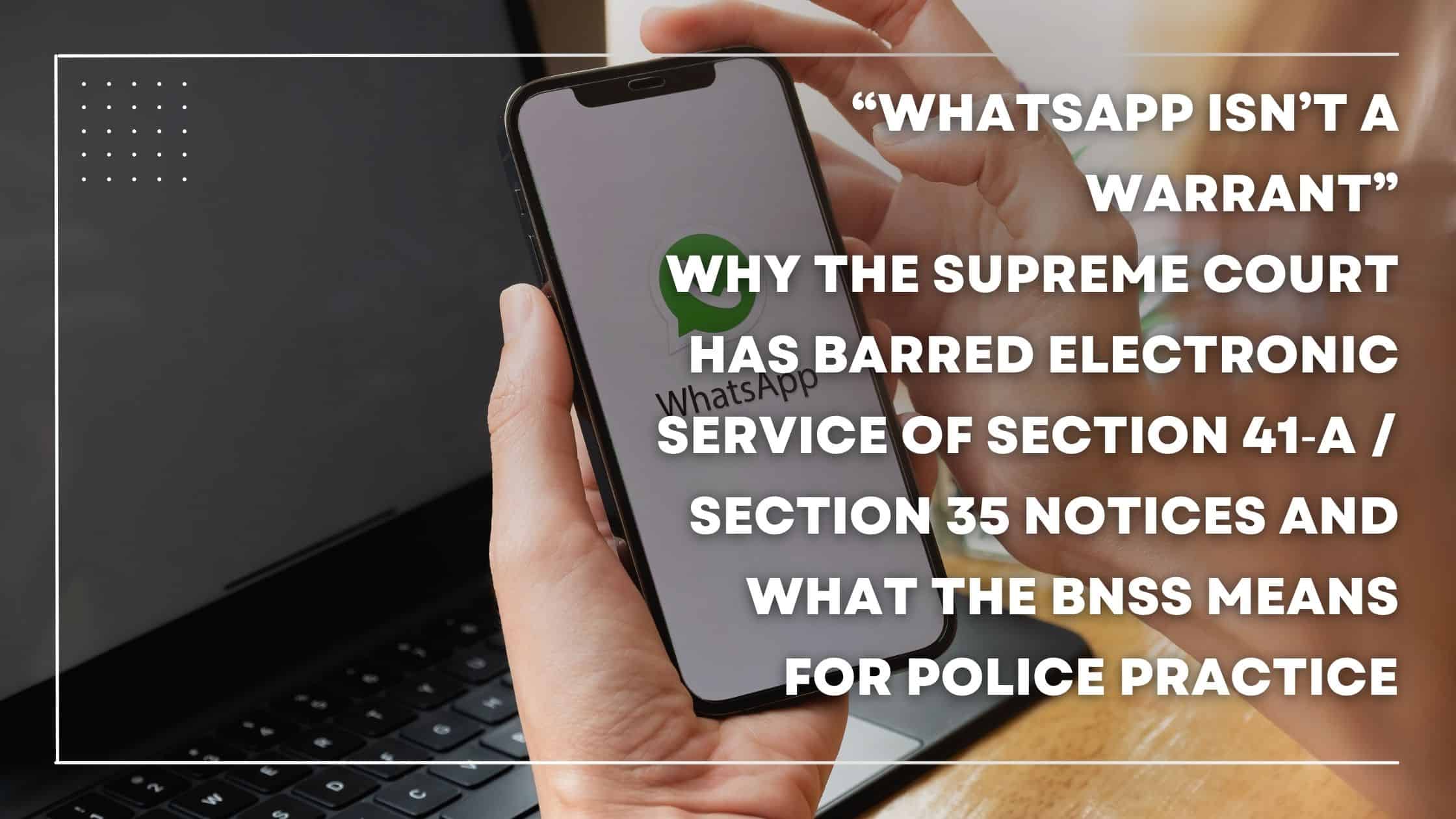
Police stations across India have, for years, tried to save time by pinging suspects on WhatsApp with a Section 41‑A CrPC notice instead of delivering it by hand. The practice looked efficient—delivery ticks, timestamps, even blue ticks as proof of reading. But on 21 January 2025, a two‑judge Bench in Satender Kumar Antil v. CBI drew a red line:
“Service of notice through WhatsApp or other electronic modes cannot be considered or recognised as an alternative or substitute to the modes of service prescribed under the CrPC, 1973 or the Bharatiya Nagarik Suraksha Sanhita, 2023 (BNSS).”
The order directs every State and Union Territory to issue standing orders forbidding electronic service of:
- Section 41‑A CrPC / Section 35 BNSS notices of appearance;
- Section 160 CrPC / Section 179 BNSS witness‑summons; and
- Section 175 CrPC / Section 195 BNSS document‑production notices.
Monthly High‑Court monitoring and the threat of contempt back the above directive.
How the jurisprudence reached breaking point
- Arnesh Kumar v. State of Bihar (2014) 8 SCC 273 – introduced the Section 41‑A CrPC notice as the primary alternative to arrest and warned that non‑compliance could invite departmental action.
- Rakesh Kumar v. Vijayanta Arya, Delhi HC (2017) – held that a WhatsApp message is not valid service of a Section 41‑A CrPC notice because Chapter VI CrPC requires personal delivery; affirmed by the Supreme Court.
- Amandeep Singh Johar v. State (NCT Delhi), Delhi HC (2018) – reiterated that informal calls or texts cannot replace a written notice; mere attendance at the police station does not cure the illegality.
- Satender Kumar Antil bail‑reform trilogy (2022‑2024) – required each High Court to set up an “Institutional Monitoring Mechanism” and asked States to file compliance affidavits.
- Compliance Order, 21 Jan 2025 – explicitly bans WhatsApp/e‑mail service and extends the rule to BNSS Sec. 35 notices.
Why the Court rejected electronic service: Concerns and Explanation
Authenticity & attribution- WhatsApp profiles can be spoofed; SIMs are frequently recycled. CrPC Sec. 62 demands a provable “handing over” of the notice.
Receipt vs. cognition- Blue ticks prove delivery, not that the addressee actually read or understood the legal consequences.
Digital divide- Over 30 % of rural adults do not use smartphones; service must be “reasonable” to satisfy natural‑justice requirements under Article 21.
Tamper‑proof record- A signed acknowledgement or witness endorsement is a contemporaneous, court‑verifiable document—superior to screenshots that can be manipulated.
Legislative intent- Parliament considered BNSS in 2023 but chose not to include electronic service in Sec. 35, signalling continuity with the CrPC regime.
The BNSS has now replaced the CrPC later this year. Although touted as “tech‑savvy,” the new code keeps the summons‑service logic intact. Section 35(2) expressly refers to “modes of service provided in this Chapter” — i.e., the traditional methods. Unless the Home Ministry frames rules under Sec. 532 BNSS or Parliament amends Sec. 35, physical service remains mandatory even after the new code kicks in.
Comparative digression: can technology be reconciled with due process?
- United Kingdom – Criminal Procedure Rules allow e‑mail service of summons only with the recipient’s prior written consent and a server‑generated delivery certificate.
- Singapore – The Criminal Procedure Code (2021 rev.) permits electronic service via the government “SingPass” e‑portal, backed by two‑factor authentication.
- Lesson for India – A statutory backbone plus audited digital signatures are prerequisites; ad‑hoc WhatsApp messages do not meet that standard.
By slamming the door on WhatsApp notices, the Supreme Court has reminded police agencies that procedural shortcuts can never trump personal liberty. Until Parliament writes a technologically neutral, tamper‑proof alternative into the BNSS, every notice of appearance must travel the old‑fashioned route—served by hand, acknowledged in ink, and verifiable in court. The judgment is therefore not anti‑technology; it is pro‑due‑process. Whether States treat it as another directive or a call to modernise criminal procedure—without sacrificing safeguards—will determine if India can combine digital efficiency with constitutional fidelity.

By:
Vijay Pal Dalmia, Advocate
Supreme Court of India & Delhi High Court
Email ID: vpdalmia@gmail.com
Mobile No.: +91 9810081079